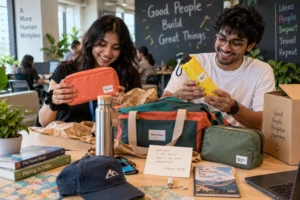
“Eco-friendly” is not a single product specification. A useful sustainable-gifting programme starts by identifying what matters to your organisation—material choice, durability, reuse, packaging, recycled content, verified sourcing, waste reduction or another measurable requirement—and then checking those claims against the exact product.
This 2026 guide helps procurement, HR and sustainability teams compare corporate gifts without relying on vague green marketing. It explains what to ask about jute, canvas, bamboo, recycled stationery, reusable drinkware, plantable products and other commonly marketed sustainable merchandise.
Start by defining what “better” means for your programme
Before selecting products, decide which environmental considerations matter most to the organisation. Examples include:
- Replacing a disposable item with a durable reusable product
- Reducing unnecessary packaging or consolidating several items into one useful kit
- Choosing a verified recycled-content product
- Choosing a natural-fibre product where the exact composition is known
- Using a product for longer rather than increasing the number of giveaway items
- Reducing transport or packaging complexity through consolidated delivery
Do not treat a material name, colour or product photograph as proof of sustainability.
Product families to compare
Jute bags
Jute can be a useful natural-fibre option for conference bags, gift packaging and promotional merchandise. Confirm the actual bag construction, fibre composition, handles, lining, lamination or coating, dimensions and intended use. A bag described as jute may still contain synthetic handles, coatings, threads or other components.
Browse custom jute bags and request product-specific material information where needed.
Canvas and cotton bags
Totes and canvas bags can be reused for events, retail, onboarding and daily carrying. Check the fabric composition, GSM where stated, handles, gusset and branding method. If recycled or organic cotton is a procurement requirement, request evidence for the exact selected product rather than assuming it from a category label.
Compare canvas and tote bags.
Bamboo and wood products
Bamboo, wood and cork products can provide a natural-material aesthetic, but the visible outer material may not describe the full product. Ask about coatings, adhesives, plastic or metal components, electronics where present, and the exact material specification. Natural grain, shade and texture can also vary between production batches.
Recycled or lower-impact stationery
Notebooks, pens and desk products may be offered with recycled paper, recycled plastic, cork, kraft or other alternative materials. If recycled content is important, ask for the percentage and source documentation available for the selected SKU. “Recycled look” or brown paper colour is not evidence of recycled content.
See notebooks and diaries and pens.
Reusable drinkware
Bottles, mugs and tumblers can reduce reliance on disposable cups or bottles when they are durable and actually used. Confirm the material, capacity, lid, insulation claims where stated, care guidance and food-contact documentation if required by your organisation. Do not infer safety certifications from the product photograph or material name.
Compare customized drinkware.
Plantable and seed products
Seed paper, seed pencils and plant kits can be engaging gifts, but germination depends on seed type, storage, climate, soil, water and handling. Germination should not be guaranteed unless the specific supplier documentation supports such a commitment. Confirm the plant or seed type, storage guidance and packaging before ordering.
Vegan-leather and leather alternatives
“Vegan leather” means the product is represented as a non-animal leather alternative; it does not automatically mean biodegradable, plastic-free, recycled or environmentally certified. Ask for the material composition and any environmental evidence required by your purchasing policy.
Browse vegan-leather gift sets.
Claims that should be verified before publication or approval
| Claim | What to request |
|---|---|
| Recycled | Material composition and recycled-content percentage where available |
| Biodegradable or compostable | Product-specific test, certification or supplier declaration and applicable conditions |
| Organic | Relevant certification or product-specific supplier evidence |
| Fair-trade or ethically sourced | Named certification or documented sourcing evidence |
| Plastic-free | Full product and packaging component review |
| Carbon-neutral / low-carbon | Defined measurement boundary, method and supporting evidence |
| Food-safe / certified | Applicable product-specific declaration or test documentation |
Usefulness and durability matter
A gift with an environmental label is not automatically a better choice if it is unlikely to be used. Consider whether the recipient has a genuine use for the product, whether the item can withstand normal use and whether the branding makes it more or less likely to be retained.
For some programmes, fewer useful items with simpler packaging can be a better procurement decision than a larger hamper containing several low-use components.
Packaging can materially change the programme
Review the outer box, inserts, fillers, plastic sleeves, protective material, labels and courier packaging—not only the gift itself. Ask whether packaging can be simplified, right-sized or consolidated without compromising product protection.
Branding and customization
Engraving, printing, embroidery, labels, sleeves or another branding method may be suitable depending on the product. The decoration method should be chosen after the selected material and surface are known. A sustainable material claim does not justify using an unsuitable print or coating process.
Budget planning without fake “green premiums”
There is no universal rule that a sustainable product costs more or less than a conventional alternative. Price depends on the exact product, material, quantity, branding, packaging, certification requirements, tax, freight and delivery split. Compare current written quotations for the same functional requirement rather than relying on generic budget tables.
Build an evidence-ready sustainable-gifting brief
- Recipient group and quantity
- Intended use of the product
- Target budget basis
- Preferred product category
- Environmental requirement that matters to the organisation
- Required certification or supplier documentation, if any
- Logo artwork and branding preference
- Packaging requirements
- Delivery city/postcode split
- Required arrival date
Questions procurement teams should ask
- What is the exact material composition?
- Which environmental claims are product-specific and which are only marketing terms?
- What supporting document is available for a recycled, organic, biodegradable or certified claim?
- What non-primary components are present, such as coatings, liners, electronics or plastic parts?
- How durable is the product for its intended use?
- Can the packaging be reduced or simplified?
- What branding method is compatible with the material?
- What is the confirmed MOQ, price and delivery schedule for this exact specification?
Frequently asked questions
Are all jute, bamboo or cork products automatically eco-friendly?
No. Material type is only one part of the product. Construction, coatings, additional components, durability, packaging and sourcing evidence also matter.
Can sustainable gifts be branded?
Many can, but the method depends on the exact surface and product. Branding feasibility and final placement should be confirmed after the product and artwork are reviewed.
What is the minimum order quantity?
MOQ depends on the selected product, branding, packaging and supplier. The final minimum is confirmed in the written quotation for the exact requirement.
Do you provide sustainability certificates?
Documentation varies by product and supplier. If a certificate or declaration is required, state that requirement before selecting the product so the available evidence can be checked.
Can we use sustainable gifts in multi-location employee programmes?
Yes, where the selected products and packing plan are suitable. Delivery structure, packing and freight are confirmed against the actual destination count and required schedule.
Request an evidence-based sustainable gifting shortlist
Share the recipient group, quantity, intended use, budget, environmental criteria, artwork, packaging and delivery plan. Merch Story can then shortlist current products and identify which sustainability claims can be supported for the selected options.
Request a sustainable corporate-gifting quotation or browse the eco-friendly corporate gifts collection.