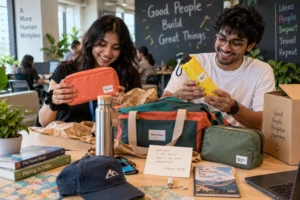
An employee welcome kit should make a new hire’s first days easier, not simply add more branded objects to their desk. A strong onboarding kit combines useful merchandise, clear company communication and a practical delivery plan around the employee’s role, location and equipment needs.
This 2026 guide explains how HR, people-operations, procurement and administration teams can plan employee welcome kits in India using real product specifications, current quotations and explicit approval steps. It is designed to help teams compare components, collect sizes, manage remote deliveries and avoid vague “one-kit-fits-all” assumptions.
What is an employee welcome kit?
An employee welcome kit is a curated set of products prepared for a new joiner or employee milestone. It may include branded merchandise, work accessories, stationery, apparel, technology items, a welcome message or a presentation box. The best kit depends on the employee role, budget, location and onboarding process.
Start with the employee journey, not the box
Before selecting products, define when and how the kit will be used:
- Day-one onboarding: practical items that help the employee start work and identify with the organisation.
- Remote onboarding: products that can be packed safely, delivered to individual addresses and used without visiting an office.
- Office joining: desk items, apparel, drinkware or bags handed over at the workplace.
- Role-specific onboarding: field teams, sales teams, technology employees and leadership may need different products.
- Milestone or recognition kits: presentation and perceived value may matter more than day-one utility.
Useful welcome-kit components
Notebooks and diaries
Useful for meetings, training and company information. Confirm the exact size, cover material, binding, page specification where stated and branding method for the selected product.
Pens and writing sets
Metal pens, plastic pens and executive writing sets can suit different budgets and recipient groups. Check the actual refill, material and engraving or print surface rather than assuming every pen supports the same branding.
Drinkware
Bottles, mugs and tumblers are common kit components because they are practical and easy to combine with other items. Confirm material, capacity, lid, insulation claims where stated and branding surface for the exact model.
Apparel
T-shirts, polos, hoodies and sweatshirts can help create team identity. Select the garment first, then collect the required quantity in each size and colour using that product’s current size chart. Do not apply one generic size ratio across different brands or fits.
Bags and laptop accessories
Backpacks, laptop bags and sleeves can be useful for office and hybrid teams. Confirm dimensions, compartments, laptop compatibility where verified, material and any warranty information for the selected product.
Technology accessories
Power banks, wireless chargers, speakers, earbuds and other technology items can suit selected programmes. Exact model, compatibility, specifications, included accessories, branding permissions and warranty basis should be confirmed before approval.
ID and desk accessories
Lanyards, card holders, desk organisers and stands can support office onboarding. Select the actual construction and attachment type before confirming artwork or quantity.
Presentation boxes and bags
Rigid boxes, totes and other outer packaging should be designed around the actual kit contents. Final dimensions, inserts and fitment should be based on the selected products rather than a generic reference photograph.
Build kits by role or use case
| Use case | Possible components to investigate | Main checks |
|---|---|---|
| Office new joiner | Notebook, pen, bottle, apparel, ID accessories | Sizes, branding, desk utility, packing |
| Remote employee | Laptop accessory, notebook, bottle, selected tech, apparel | Device compatibility, secure address handling, shipping |
| Field or sales team | Polo, cap, bag, bottle, notebook | Fit, material, portability, logo placement |
| Technology team | Backpack, sleeve, charger, notebook, apparel | Device specifications, warranty, compatibility |
| Leadership onboarding | Premium bag, writing set, diary, drinkware, presentation box | Material, presentation, discreet branding, proof |
Use budget bands as planning ranges
There is no universal kit price. The delivered cost depends on the exact products, quantity, branding, personalization, packaging, tax, freight and delivery split. Use a budget band to shortlist products, then request a current quotation for the final kit.
- Simple kits: focus on a few practical components with straightforward branding.
- Standard onboarding kits: combine stationery, drinkware, apparel or a bag.
- Premium kits: add higher-value bags, executive accessories, technology items or presentation packaging.
- Role-specific kits: use fewer but more relevant components rather than increasing item count.
Branding and personalization
Printing, embroidery, engraving, embossing, UV printing, labels and branded packaging may be suitable for different products. The appropriate method depends on the selected material, artwork, quantity and desired finish.
- Share the original logo or artwork.
- State whether the branding should be subtle or prominent.
- Keep per-product placement separate inside multi-item kits.
- Use employee names only where the chosen product and process support reliable personalization.
- Approve the final artwork or proof before bulk production where required.
Illustrative preview versus production proof
For supported products, Merch Story’s Design Studio may provide an illustrative preview. That preview helps a buyer review the visual direction, but it is not automatically a supplier-approved manufacturing proof. Final print area, method, colour reproduction and production feasibility must be confirmed for the selected product.
Collect apparel sizes accurately
Choose the actual garment before collecting sizes. Use the current product size chart and record quantities by size and colour. If fit is critical, ask about the available sample route before a large order. Avoid copying a size matrix from a different brand or style.
Plan remote and multi-location delivery securely
For remote employees or multiple offices, first confirm the products, quantities and packing method. Then define the number of delivery locations. Personal addresses and phone numbers should be transferred only through the agreed fulfilment process when required; they should not be placed in public enquiry text.
Sample and approval options
A digital mock-up or physical sample may be available depending on the selected products and programme. Sample availability, preparation time and any charge are confirmed for the exact requirement. Keep the approved product references, artwork and proof revision with the purchasing record.
Welcome-kit brief: what procurement should send
- Employee or recipient group
- Total number of kits
- Budget basis
- Preferred components or product links
- Apparel size split where relevant
- Device requirements where relevant
- Logo artwork and brand-colour references
- Name-personalisation requirement, if any
- Packaging requirement
- Delivery city/postcode split or number of individual addresses
- Required arrival date
- Sample or proof requirement
How to compare two welcome-kit quotations
- Compare the exact components and product models, not only the total price.
- Check whether branding is included for every component or only selected items.
- Verify packaging, inserts and packing labour.
- Confirm taxes and freight.
- Check the approved artwork or proof route.
- Confirm the product-specific MOQ and schedule in writing.
- Record how substitutions will be handled if a component becomes unavailable.
Frequently asked questions
What should an employee welcome kit contain?
There is no mandatory set of items. Start with the employee role and onboarding process, then choose useful components such as stationery, drinkware, apparel, bags or selected technology accessories.
What is the minimum order quantity?
MOQ depends on the selected kit components, branding method, packaging and supplier. The final minimum is confirmed in the written quotation for the exact requirement.
How long does production take?
Production and delivery timing are product-specific. The current schedule is confirmed after the products, quantity, artwork, approvals, packing and destination plan are known.
Can we get a sample first?
Sample availability and any charge are confirmed for the selected products and quantity. Some projects may use a digital mock-up, physical sample or another approval route.
Can kits be delivered directly to employees?
Individual delivery can be planned after the address count, packing method and delivery window are reviewed. Personal address data should be shared through the agreed secure fulfilment process.
Can the same logo be used across all items?
The same brand artwork can be reused, but each product needs its own appropriate placement, size and decoration method. A position that works on a T-shirt does not automatically work on a bottle, bag or diary.
Request an employee welcome-kit quotation
Start with the recipient group, total quantity, target budget, preferred components, branding requirements and delivery plan. Merch Story can then confirm live product options, MOQ, sample or proof route, packing, tax, freight and schedule for the final kit.
Request a welcome-kit quotation or browse the employee welcome-kit collection.